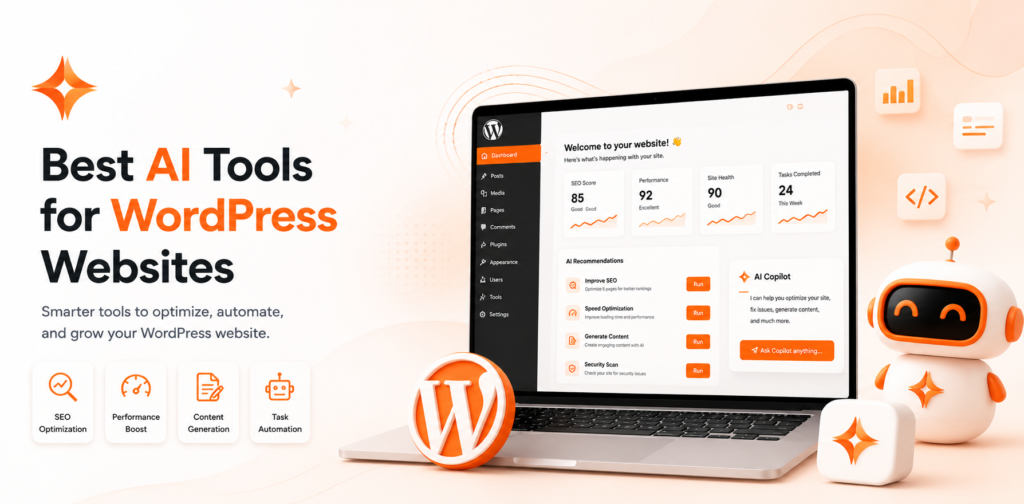
Best AI Tools for WordPress Websites in 2026
Artificial intelligence has become one of the biggest shifts in the WordPress ecosystem since the introduction of page builders and modern SEO plugins. In 2026, businesses are no longer asking whether they should use AI tools on their WordPress websites — they are asking which AI tools are actually worth using, which ones improve productivity, and which ones provide real business value rather than just marketing hype.
The demand for the best AI tools for WordPress websites has exploded because website owners are under more pressure than ever before. Businesses need to publish more content, rank higher on Google, improve Core Web Vitals, automate support systems, optimize conversions, and manage websites at scale — often with smaller teams and tighter budgets. AI tools are becoming the operational layer that makes this possible.
WordPress itself powers more than 40% of all websites globally, according to WordPress.org. At the same time, AI adoption in marketing, development, SEO, and customer support continues to accelerate rapidly. The overlap between WordPress and AI is now creating entirely new workflows that simply did not exist a few years ago.
Today, the best AI tools for WordPress websites can:
- Generate SEO-optimized blog posts
- Improve website performance automatically
- Create product descriptions for WooCommerce
- Build AI-powered chatbots
- Generate custom code snippets
- Improve accessibility
- Optimize metadata and schema
- Automate email marketing
- Generate featured images
- Predict customer behavior
- Improve conversion rates
- Reduce repetitive manual tasks
But not all AI tools are equally useful. Some genuinely improve business operations. Others create more complexity than value. The goal of this guide is to break down the best AI tools for WordPress websites in 2026, explain what they are best at, who should use them, where they fit into a real workflow, and how businesses are actually using them successfully.
Table of Contents
- Why AI Tools Matter for WordPress Websites
- The Different Types of AI Tools for WordPress
- Best AI SEO Tools for WordPress Websites
- Best AI Content Generation Tools
- Best AI Design and Image Generation Tools
- Best AI Chatbots and Customer Support Tools
- Best AI Automation Tools
- Best AI Developer Tools for WordPress
- Best AI Tools for WooCommerce Stores
- Best AI Performance Optimization Tools
- Best AI Security Tools for WordPress
- How Agencies Use AI for WordPress Websites
- Common Mistakes When Using AI on WordPress
- The Future of AI and WordPress
- Frequently Asked Questions
Why AI Tools Matter for WordPress Websites in 2026
The biggest reason businesses are adopting the best AI tools for WordPress websites is efficiency. Modern websites are expected to do far more than they were five years ago. A single WordPress website today often needs:
- SEO optimization
- Blog publishing
- Lead generation
- Email marketing integration
- Analytics tracking
- Customer support
- Performance optimization
- Security monitoring
- Conversion optimization
- Social media integration
Without automation and AI assistance, managing all of this becomes expensive and time-consuming.
AI tools reduce the amount of repetitive work needed to operate modern websites. Instead of manually writing every meta description, compressing every image, analyzing every SEO issue, or answering every customer question, AI systems now automate significant portions of these workflows.
This is especially important for:
- Small businesses with limited teams
- Agencies managing multiple websites
- WooCommerce store owners
- Affiliate marketers
- Publishers and bloggers
- SaaS companies using WordPress marketing sites
The websites benefiting the most from the best AI tools for WordPress websites are not replacing humans entirely. Instead, they are using AI to remove low-value repetitive tasks so teams can focus on strategy, creativity, branding, and growth.

The Different Types of AI Tools for WordPress
One reason the search term best AI tools for WordPress websites has become so broad is because AI now affects nearly every part of website management.
AI tools for WordPress generally fall into several major categories:
1. AI SEO Tools
These tools help optimize content, metadata, internal linking, schema markup, keyword targeting, and SERP analysis.
2. AI Content Generation Tools
These tools generate blog posts, landing page copy, WooCommerce descriptions, FAQs, email campaigns, and social media captions.
3. AI Design Tools
These tools create images, website mockups, banners, illustrations, thumbnails, and social graphics.
4. AI Automation Platforms
Automation systems connect WordPress websites to CRMs, marketing systems, analytics tools, and external APIs.
5. AI Chatbots and Support Tools
These systems automate customer support, answer FAQs, qualify leads, and improve customer experience.
6. AI Development Tools
These help developers generate code, debug issues, create templates, and accelerate WordPress plugin/theme development.
7. AI Analytics and Conversion Tools
These platforms analyze user behavior and recommend improvements to increase conversions and engagement.
Best AI SEO Tools for WordPress Websites
SEO remains one of the most important use cases for AI in WordPress. Search engines are becoming more sophisticated, and ranking competitive content manually is significantly harder than it was several years ago.
The best AI SEO tools for WordPress websites help with:
- Keyword optimization
- SERP analysis
- Metadata generation
- Schema markup
- Internal linking
- Technical SEO
- Readability improvements
- Topic clustering
1. :contentReference[oaicite:0]{index=0}
Rank Math has become one of the strongest AI-enhanced SEO plugins available for WordPress websites. Its Content AI system helps website owners optimize content directly inside the WordPress editor.
Features include:
- AI content recommendations
- Keyword optimization scoring
- Automated schema markup
- SEO analysis
- Internal linking suggestions
- WooCommerce SEO support
- Advanced sitemap management
For many businesses, Rank Math is one of the best AI tools for WordPress websites because it combines automation with strong technical SEO features.
Related reading:
WordPress SEO Checklist for 2026
2. :contentReference[oaicite:1]{index=1}
Surfer SEO uses AI-driven SERP analysis to help writers optimize content based on pages already ranking on Google.
Surfer analyzes:
- Keyword density
- Heading structure
- Competitor content length
- Semantic keywords
- Search intent alignment
For long-form SEO content, Surfer remains one of the best AI tools for WordPress websites focused on organic traffic growth.
3. :contentReference[oaicite:2]{index=2}
Semrush has integrated AI deeply into its SEO ecosystem. Businesses use it for:
- Keyword research
- Competitive analysis
- Content gap discovery
- SEO auditing
- AI writing assistance
Large agencies managing multiple WordPress websites often combine Semrush with Rank Math or Surfer SEO.
4. :contentReference[oaicite:3]{index=3}
Ahrefs remains one of the most powerful SEO research platforms available. Its AI-powered keyword clustering and search intent analysis are especially valuable for publishers and agencies scaling content production.
Best AI Content Generation Tools for WordPress
Content generation is where AI has had perhaps the biggest impact on WordPress workflows.
The best AI tools for WordPress websites now allow businesses to:
- Create long-form blog posts
- Generate landing page copy
- Write WooCommerce descriptions
- Create FAQs
- Generate ad copy
- Write newsletters
- Create social media posts
1. :contentReference[oaicite:4]{index=4}
ChatGPT remains one of the most versatile AI tools available for WordPress users.
Businesses use ChatGPT to:
- Generate article outlines
- Write SEO content
- Create FAQs
- Improve readability
- Generate meta descriptions
- Create content briefs
- Translate content
Its flexibility makes it one of the best AI tools for WordPress websites overall.
2. :contentReference[oaicite:5]{index=5}
Claude AI has become especially popular for long-form writing because of its natural tone and strong structure capabilities.
Many agencies prefer Claude for:
- SEO pillar pages
- Long-form educational content
- Content rewrites
- Research summarization
- Brand voice consistency
3. :contentReference[oaicite:6]{index=6}
Jasper AI focuses heavily on marketing and conversion-focused writing.
It is commonly used for:
- Sales pages
- Email campaigns
- Facebook ads
- Product copy
- Marketing funnels
4. :contentReference[oaicite:7]{index=7}
Copy.ai remains popular for shorter-form marketing content and workflow automation.
Related reading:
Best WordPress Plugins for Business Websites

Best AI Design and Image Generation Tools
Visual content has become essential for SEO, branding, and conversion optimization.
The best AI tools for WordPress websites now include advanced image generation systems capable of creating:
- Featured blog images
- Landing page visuals
- Product banners
- Social media graphics
- Illustrations
- Background artwork
- Marketing creatives
1. :contentReference[oaicite:8]{index=8}
Midjourney is widely used by marketers, agencies, and bloggers for generating highly cinematic visuals.
WordPress users frequently use Midjourney for:
- Featured images
- Brand concepts
- Hero section backgrounds
- Ad creatives
- Custom illustrations
2. :contentReference[oaicite:9]{index=9}
Canva has expanded its AI features dramatically.
AI tools inside Canva now include:
- Magic Design
- AI image generation
- AI background removal
- Automatic resizing
- AI text generation
For non-designers managing WordPress websites, Canva remains one of the easiest AI tools to integrate into daily workflows.
3. :contentReference[oaicite:10]{index=10}
Adobe Firefly is increasingly used by agencies and enterprise businesses needing commercial-quality AI-generated assets.
Best AI Chatbots and Customer Support Tools
Customer expectations have changed significantly. Visitors expect instant responses, immediate answers, and 24/7 availability.
This is why AI chatbots are becoming one of the fastest-growing categories among the best AI tools for WordPress websites.
1. :contentReference[oaicite:11]{index=11}
Tidio combines live chat with AI-powered automation.
Features include:
- AI-generated support replies
- Lead qualification
- WooCommerce support automation
- Visitor behavior tracking
- FAQ automation
2. :contentReference[oaicite:12]{index=12}
Intercom uses AI extensively for customer onboarding and support systems.
Many SaaS businesses running WordPress marketing websites use Intercom to automate:
- Onboarding flows
- Help centers
- Knowledge bases
- Customer support routing
3. :contentReference[oaicite:13]{index=13}
Crisp is popular among startups and small businesses because of its simpler pricing and clean interface.
Best AI Automation Tools for WordPress Websites
Automation platforms are helping WordPress businesses connect dozens of systems together.
1. :contentReference[oaicite:14]{index=14}
Zapier connects WordPress with CRMs, spreadsheets, AI systems, marketing platforms, and analytics tools.
Popular WordPress automations include:
- Lead capture workflows
- AI-generated email sequences
- Slack notifications
- CRM synchronization
- Social media automation
2. :contentReference[oaicite:15]{index=15}
Make is increasingly popular for advanced automation workflows involving APIs and AI systems.
Agencies often use Make to build:
- AI publishing pipelines
- Automated reporting systems
- SEO monitoring workflows
- Content distribution automations
3. :contentReference[oaicite:16]{index=16}
n8n has become especially popular among developers wanting self-hosted automation systems.

Best AI Developer Tools for WordPress
AI coding assistants are dramatically changing WordPress development workflows.
1. :contentReference[oaicite:17]{index=17}
GitHub Copilot helps developers generate PHP, JavaScript, CSS, and SQL code significantly faster.
Developers use it for:
- Plugin development
- Theme customization
- Debugging
- WordPress hooks
- WooCommerce customizations
2. :contentReference[oaicite:18]{index=18}
Cursor is rapidly becoming one of the most popular AI-native code editors for developers building WordPress websites.
3. :contentReference[oaicite:19]{index=19}
VS Code combined with AI extensions remains one of the most common WordPress development environments.
Related reading:
How to Speed Up WordPress Websites
Best AI Tools for WooCommerce Stores
WooCommerce websites are among the biggest adopters of AI because eCommerce workflows involve large amounts of repetitive operational work.
The best AI tools for WordPress websites running WooCommerce help automate:
- Product descriptions
- Email marketing
- Upsell recommendations
- Support systems
- Inventory management
- Analytics
- Review generation
1. :contentReference[oaicite:20]{index=20}
Klaviyo uses predictive AI for email personalization and customer segmentation.
2. :contentReference[oaicite:21]{index=21}
Mailchimp continues integrating AI features for automation and email optimization.
3. :contentReference[oaicite:22]{index=22}
ShopEngine integrates WooCommerce customization with automation-focused workflows.
Best AI Performance Optimization Tools
Website speed directly affects SEO rankings, conversions, and user experience.
1. :contentReference[oaicite:23]{index=23}
WP Rocket automates many performance optimization processes including:
- Caching
- CSS optimization
- JavaScript delay
- Database cleanup
- Core Web Vitals improvements
2. :contentReference[oaicite:24]{index=24}
Perfmatters helps reduce unnecessary scripts and optimize frontend performance.
3. :contentReference[oaicite:25]{index=25}
NitroPack uses automated optimization systems to improve performance scores dramatically.
Best AI Security Tools for WordPress Websites
Security threats against WordPress websites continue increasing every year.
AI-powered security systems now help detect suspicious behavior faster than traditional rule-based systems alone.
1. :contentReference[oaicite:26]{index=26}
Wordfence uses intelligent threat detection and firewall systems to protect WordPress websites.
2. :contentReference[oaicite:27]{index=27}
Sucuri provides malware scanning, monitoring, and firewall protection.
3. :contentReference[oaicite:28]{index=28}
Cloudflare uses intelligent traffic analysis and AI-enhanced security protections at the network level.

How Agencies Use AI for WordPress Websites
Agencies are among the biggest adopters of AI tools because they manage multiple client websites simultaneously.
Modern agencies use the best AI tools for WordPress websites to:
- Accelerate content production
- Generate proposals
- Automate reporting
- Optimize SEO workflows
- Improve development speed
- Create design assets
- Handle support systems
Instead of replacing employees entirely, AI allows agencies to scale operations without needing proportional increases in team size.
For example:
- A content writer using AI can produce 3–5x more content
- A developer using AI assistants can build features faster
- A support system using AI chatbots can reduce repetitive tickets
- An SEO specialist can automate technical audits
Common Mistakes When Using AI on WordPress Websites
1. Publishing Raw AI Content Without Editing
AI-generated content should always be reviewed for accuracy, tone, SEO optimization, and originality.
2. Installing Too Many AI Plugins
Adding excessive plugins can slow down websites and create conflicts.
3. Ignoring Human Creativity
The best-performing websites combine AI efficiency with human creativity and strategy.
4. Using AI Without Clear Workflows
AI tools work best when integrated into structured operational systems.
5. Expecting AI to Replace Expertise Completely
AI improves productivity, but strategy, branding, UX, and business decisions still require human judgment.
The Future of AI and WordPress Websites
The future of WordPress and AI is moving toward intelligent, adaptive websites capable of:
- Personalizing content dynamically
- Optimizing SEO automatically
- Predicting user behavior
- Generating layouts in real time
- Automating accessibility improvements
- Improving conversions through AI testing
We are also beginning to see the rise of AI-native WordPress workflows where websites continuously optimize themselves based on user behavior and analytics data.
The businesses adopting the best AI tools for WordPress websites early are likely to have a major operational advantage over competitors still relying entirely on manual systems.
Frequently Asked Questions
What are the best AI tools for WordPress websites in 2026?
Some of the best AI tools for WordPress websites include Rank Math, ChatGPT, Claude, Surfer SEO, Zapier, GitHub Copilot, Midjourney, WP Rocket, Tidio, and Semrush.
Can AI improve WordPress SEO?
Yes. AI SEO tools help optimize keywords, metadata, schema, readability, internal linking, and search intent alignment.
Are AI plugins safe for WordPress websites?
Most reputable AI plugins are safe when installed from trusted developers and kept updated regularly.
Can AI fully build a WordPress website?
AI can assist with layouts, content, code generation, and automation, but human oversight remains important for branding, UX, and strategy.
What is the best AI content generator for WordPress?
ChatGPT and Claude are currently among the most widely used AI writing tools for WordPress websites.
Do AI tools slow down WordPress websites?
Some plugins can affect performance, but many AI tools operate externally through APIs and have minimal impact when configured correctly.
Final Thoughts on the Best AI Tools for WordPress Websites
The best AI tools for WordPress websites in 2026 are fundamentally changing how websites are managed, optimized, and scaled.
AI is no longer just an experimental layer on top of WordPress. It is becoming part of the core operational workflow for:
- SEO
- Content marketing
- Customer support
- Development
- Automation
- Performance optimization
- WooCommerce growth
The businesses benefiting most are not blindly automating everything. They are strategically identifying repetitive bottlenecks and using AI to improve those workflows while still maintaining human oversight for creativity, branding, and strategic decision-making.
As AI continues evolving, the gap between websites using intelligent automation effectively and websites relying entirely on manual systems will likely become significantly larger.
Related articles: